Fractional CTO: Strategic Bridge to Your First Full-Time Hire
April 2, 2026
About this solution
Problem this solves
You've built a £2-8M revenue SaaS business on technical co-founders or a small engineering team, but you're starting to feel the absence of strategic technical leadership. Hiring a full-time CTO feels expensive and risky when you're not sure what the role actually needs to do in your business. The window for getting this wrong is closing—the decisions you make now about technical architecture, hiring, and vendor strategy will constrain your next 18 months.
Approach
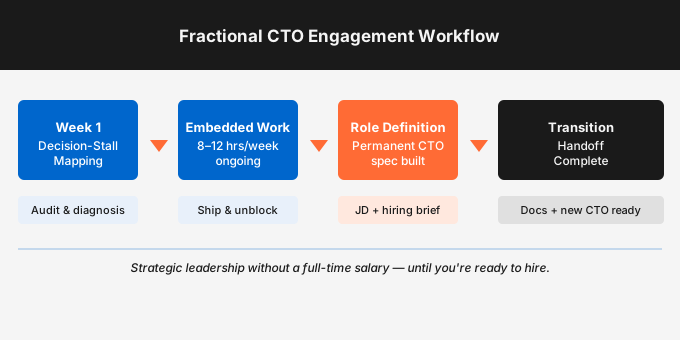
I embed as your CTO for 8-12 weeks (typically 2-3 days per week) to assess the actual technical gaps, build a credible technical roadmap, set hiring criteria for your first permanent CTO, and establish the operating rhythm they'll inherit. This is not a permanent replacement—it's the difference between hiring the right CTO and hiring someone who looks right on paper but discovers the role is broken six months in. I work directly with your founders and engineering leads to translate business constraints into technical strategy, then hand over to your permanent hire with documented context they couldn't have built themselves.
Insight
Most founders think the fractional CTO problem is 'we need a CTO but can't afford one yet.' It's actually 'we need to know what a CTO should do here before we hire one.' I've seen founders structure permanent CTO roles wrong because they hire before they've stress-tested what the role actually solves. The fractional engagement fixes the sequencing—you hire for closure and knowledge transfer, not to discover what you need. The counterargument: if you're in a genuine crisis (major security incident, critical hire retention risk, imminent Series A due diligence), a fractional CTO acting as a tactical firefighter often isn't the answer. You need permanence. I'm honest about that upfront.
In practice
A fintech SaaS founder at £3.2M ARR had five engineers, no documented architecture decisions, and was about to hire their first CTO. I spent 10 weeks (18 hours per week) reverse-engineering their codebase, interviewing each engineer, and mapping what technical decisions were holding back their next 24 months of product roadmap. We identified three critical hires they needed before a CTO (a DevOps engineer and two backend engineers), rewrote their deployment process from manual to CI/CD, and documented a technical strategy that made the permanent CTO role defensible to the board. The founder hired a permanent CTO three months later and handed them a 90-day structured onboarding plan instead of chaos. The new CTO was productive from week one because the role's actual scope had been de-risked beforehand.
Scope and fit
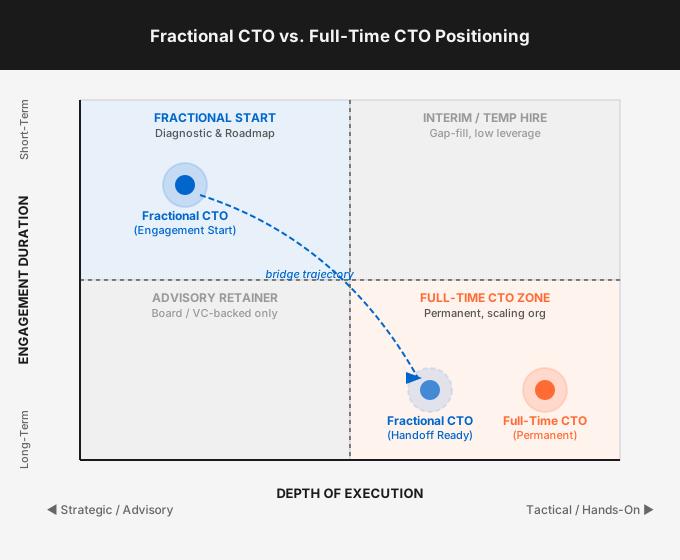
Best fit: technology founders or VPs of Engineering at £1.5-10M ARR with 4-25 engineers who have never had a CTO and are either about to hire one or know they should. Prerequisites: honest access to your technical leadership and willingness to act on uncomfortable findings about your codebase or team structure. Out of scope: serving as a permanent technical leader if your business is pre-product-market-fit or genuinely chaos-mode; tactical code-writing or hands-on engineering work (I'm not your ninth engineer); filling genuine C-suite permanence gaps for longer than 12 weeks.
Expertise
11 years building and scaling technical teams, starting from a 5-engineer function at a £40M SaaS startup through acquisition, then taking that experience into fractional advisory across 12-18 engagements. I've hired, fired, and promoted CTOs—I know what makes the role work and what makes it fail. I'm fluent in the infrastructure and hiring problems that constrain mid-market SaaS growth, but I'm honest about what I don't know (board-level politics, PE acquisition playbooks, hardcore AI engineering).
Contact
Loading…