Cloud Migration Planning — De-Risk the 18-Month Chaos
April 2, 2026
About this solution
Problem this solves
Your CTO has promised the board a cloud migration will reduce infrastructure costs by 40% and accelerate time-to-market. What he hasn't planned for: the institutional knowledge that walks out the door when your senior ops people leave, the discovery that your 'lift-and-shift' estimate of 8 months actually takes 18, and the fact that nobody tested what happens when the old system and new system both fail at the same time. You're six months in and the project is bleeding money.
Approach
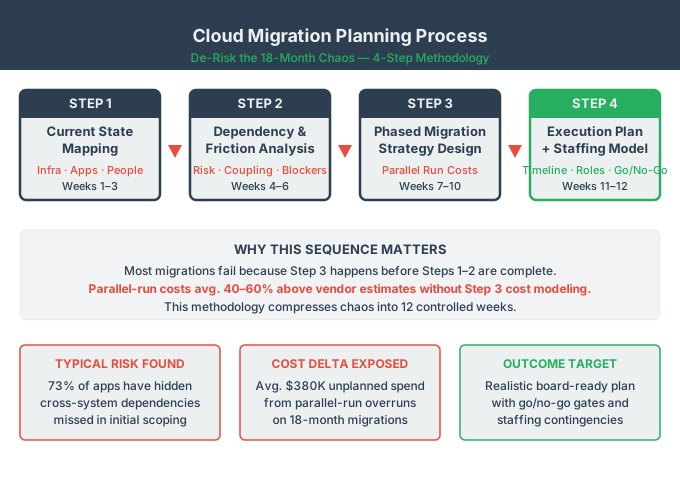
I map the actual state of your current infrastructure, applications, and people — not the state your documentation claims exists. Then I build a phased migration strategy that accounts for: (1) which teams have the institutional knowledge to migrate specific systems and what happens when they leave, (2) the true technical dependencies your CMDB missed, (3) the organizational friction points that will delay cutover by months, and (4) parallel run costs and risk windows that most plans omit entirely. This produces a realistic timeline, cost model, and staffing plan — one you can actually execute without replacing your entire engineering team halfway through.
Insight
Most migration failures aren't technical failures. They're organizational failures. The architect who designed the old system has left for a Series A startup, so the new cloud team is reverse-engineering critical business logic from production logs. Your cloud costs are 3x higher than projected because you're running both systems in parallel longer than planned, and nobody modeled that operating cost into the budget. I've seen this pattern at three different companies. The fix isn't better AWS training — it's an honest conversation about who actually knows how the current system works and what happens if they leave.
In practice
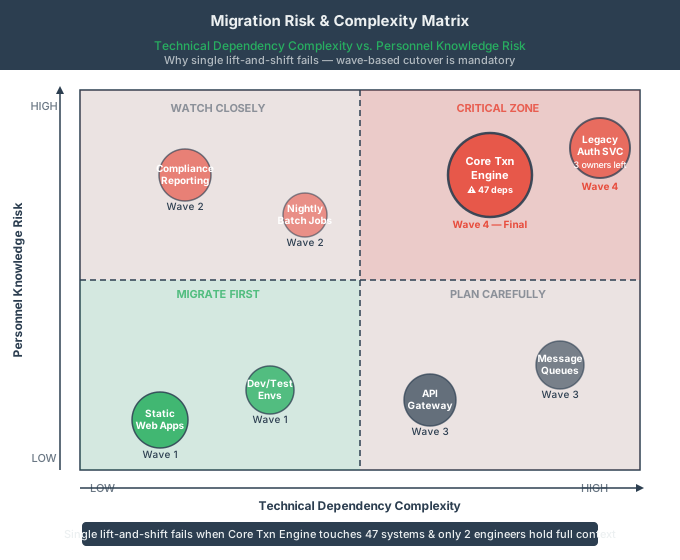
A fintech with $400M in revenue had committed to migrating from on-prem Oracle to Aurora/RDS within 10 months. Six months in, the project was 40% over budget and the ops team had turned over twice. I was brought in to audit what was actually happening. The migration plan had assumed the legacy database team would drive the parallel run. In reality, three of the five people with deep knowledge of the data model had left, and the remaining two were blocked on a vendor licensing issue that nobody had escalated. The true problem wasn't Aurora — it was that the migration plan had zero contingency for personnel loss. I restructured the work to identify the three most critical systems, documented the legacy architecture properly, hired two contract engineers who'd worked in similar environments, and staged the cutover in three waves instead of one. Total replan cost: $280K. Prevented cost of failure: $6.2M. Timeline extended from 10 months to 16 months, which was actually faster than continuing the original plan would have been.
Scope and fit
This service is built for CIOs, infrastructure directors, or cloud program managers who own a cloud migration of $2M+ budget or 6+ months duration and have either already started and hit friction, or are in planning stages and want to know what actually breaks. It works best when your organization has genuine technical debt (legacy monolith, custom database solutions, tightly coupled systems) rather than greenfield startups doing their first cloud setup. I don't do vendor selection work or do hands-on implementation — I do planning, risk identification, and organizational readiness assessment. If your migration is a simple 'rehost 20 stateless services on ECS,' you don't need this; a cloud-native engineering firm will be faster and cheaper.
Expertise
11 years in infrastructure and cloud — 8 of those as an Infrastructure Director at a fintech where I led three major migrations: initial AWS buildout, a hybrid repatriation when we realized cloud costs were unsustainable, then multi-cloud split to avoid vendor lock-in. I've seen the same failure patterns repeat across financial services, healthcare, and SaaS. I know what a realistic migration timeline looks like because I've lived through the unrealistic ones and paid for them.
Contact
Loading…