Cloud Cost Discipline: Migration Strategy & Ongoing Spend Governance
April 2, 2026
About this solution
Problem this solves
You've migrated to cloud. Your bill is 35–45% higher than on-premises for the same workloads. Nobody owns cloud spend the way finance owned capex. The architecture is fine. The cost discipline doesn't exist. You need someone to rebuild how your organisation thinks about cloud as a continuous cost problem, not a one-time migration project.
Approach
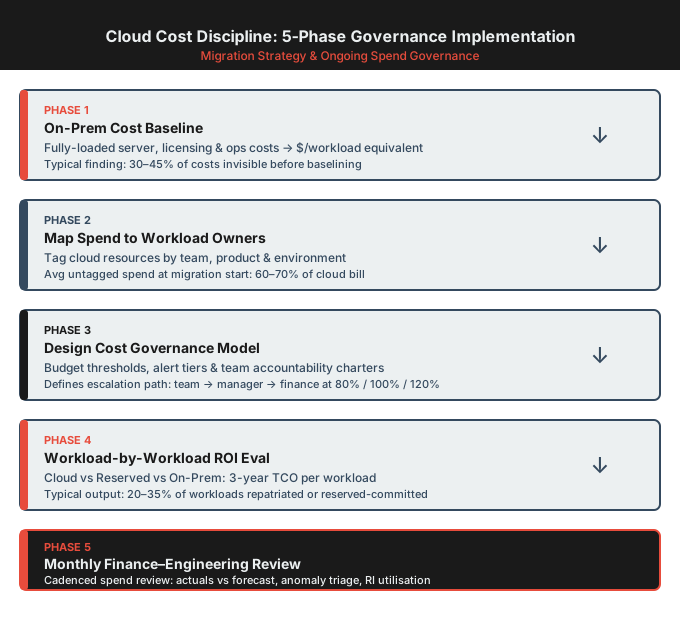
We start by establishing what 'equivalent' actually costs on your current infrastructure, then map cloud spend to workload ownership. Most organisations can't answer this question. From there, we design a cost governance model that embeds ownership into engineering teams and finance reviews—not as audit, but as monthly operating rhythm. We then identify which workloads genuinely need cloud economics (elasticity, global scale, specialised services) versus which are static and cheaper on-premises or reserved instances. Migration strategy follows from cost clarity, not the reverse.
Insight
The CFO doesn't trust the cloud bill because the data team has never shown them the before-state appraisal with credibility. Finance leaders measure capex commitment and depreciation; cloud spend looks like operational chaos by comparison. You won't fix this by hiring a FinOps tool. You fix it by giving finance a cost baseline in their language first, then showing how cloud spend deviates from it. When the VP Finance stops asking 'why is this so expensive?' and starts asking 'which teams own this variance?', you've built a cost discipline that survives leadership changes.
In practice
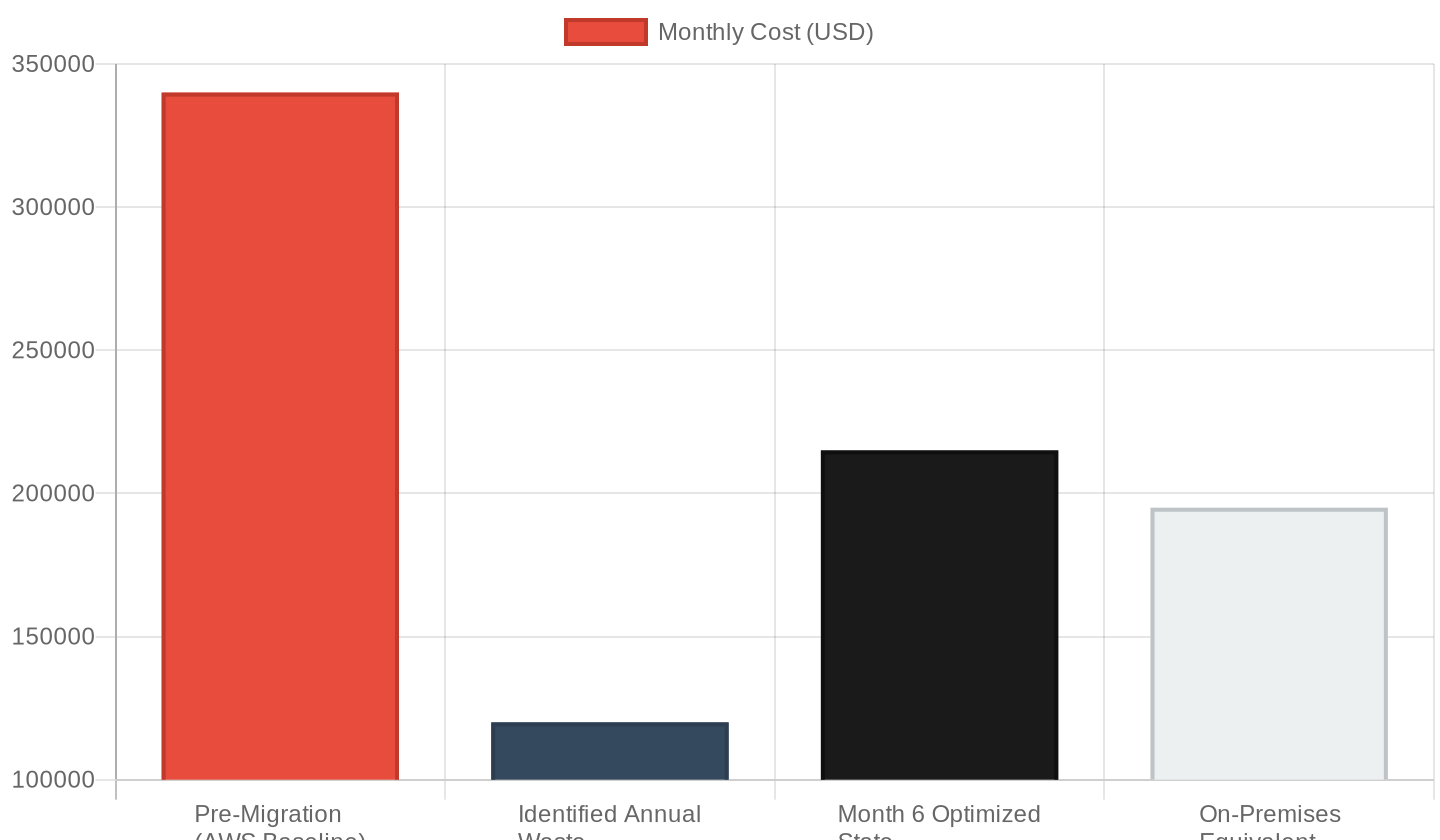
A mid-market SaaS company with 180 engineers had migrated 70% of workload to AWS over 18 months. Monthly bill reached $340K. On-premises equivalent was $195K annually (depreciated). We discovered: reserved instances covered 12% of actual compute spend; database workloads ran 3x larger than on-prem capacity; nobody had shut down non-production environments post-migration. We rebuilt their cost model to map spend to 8 engineering teams, set quarterly budgets against on-prem baselines, and identified $1.2M in annual waste within the first 60 days—most recoverable within 90 days. Cost stabilised at $215K monthly within 6 months. The change wasn't technical. It was embedding a finance-engineering review rhythm that treated cloud spend like a controlled budget, not an unlimited utility.
Scope and fit
Best fit: engineering leaders (VPs, CTOs) or finance partners (CFOs, controllers) at companies with 100–2,000 employees that have completed initial cloud migration but can't reconcile cost expectations. You have an active cloud environment and a cost problem you can measure. Out of scope: greenfield migrations where you haven't yet built baseline cost data, or organisations where cloud adoption hasn't yet reached 40% of workload—too early to establish meaningful governance. Not a fit if your organisation treats cloud as a cost centre with no accountability to business units.
Expertise
11 years as operator and advisor focused on cloud economics at scale. Spent 8 years as VP Infrastructure scaling a SaaS company from 50 to 500 engineers through two major cloud migrations, managing the capex-to-opex transition and the cost discipline that went with it. Founded independent advisory practice focused on cost governance and migration strategy. Completed 18–24 engagements across SaaS, fintech, and mid-market tech, with consistent pattern: cost problems are ownership problems, not architecture problems.
Contact
Loading…