AI Implementation Without the Reorg: Process-First Adoption for 10-50 Person Teams
April 2, 2026
About this solution
Problem this solves
Most small business owners treat AI implementation as a software purchase: pick a tool, roll it out, hope the team uses it. Within 3 months, adoption stalls because nobody redesigned the work around it. The tool isn't the problem. The process is. You're a founder or operations leader watching AI investments sit unused while your team stays stuck on manual work.
Approach
I start by mapping the actual work—not the org chart version, the version your team actually does. Then I identify which 2-3 high-friction processes are costing you the most time or money, not which ones sound good for AI. We prototype one workflow change at a time using specific tools (ChatGPT for content, Claude for analysis, Make.com for orchestration—whatever fits the actual problem), measure whether the change sticks for 30 days, and only then move to the next one. The goal is adoption that lasts because the work is genuinely easier, not because you mandated it.

Insight
Most founders assume their team resists AI because they're uncomfortable with change. The real signal is different: if your team isn't using the tool after two weeks, they're telling you the redesign didn't actually reduce their friction—it just added complexity. The CFO who doesn't trust the automated report is not being old-fashioned. She's telling you the new process skipped a control she knew was necessary. Listen to that resistance as data, not pushback.
In practice
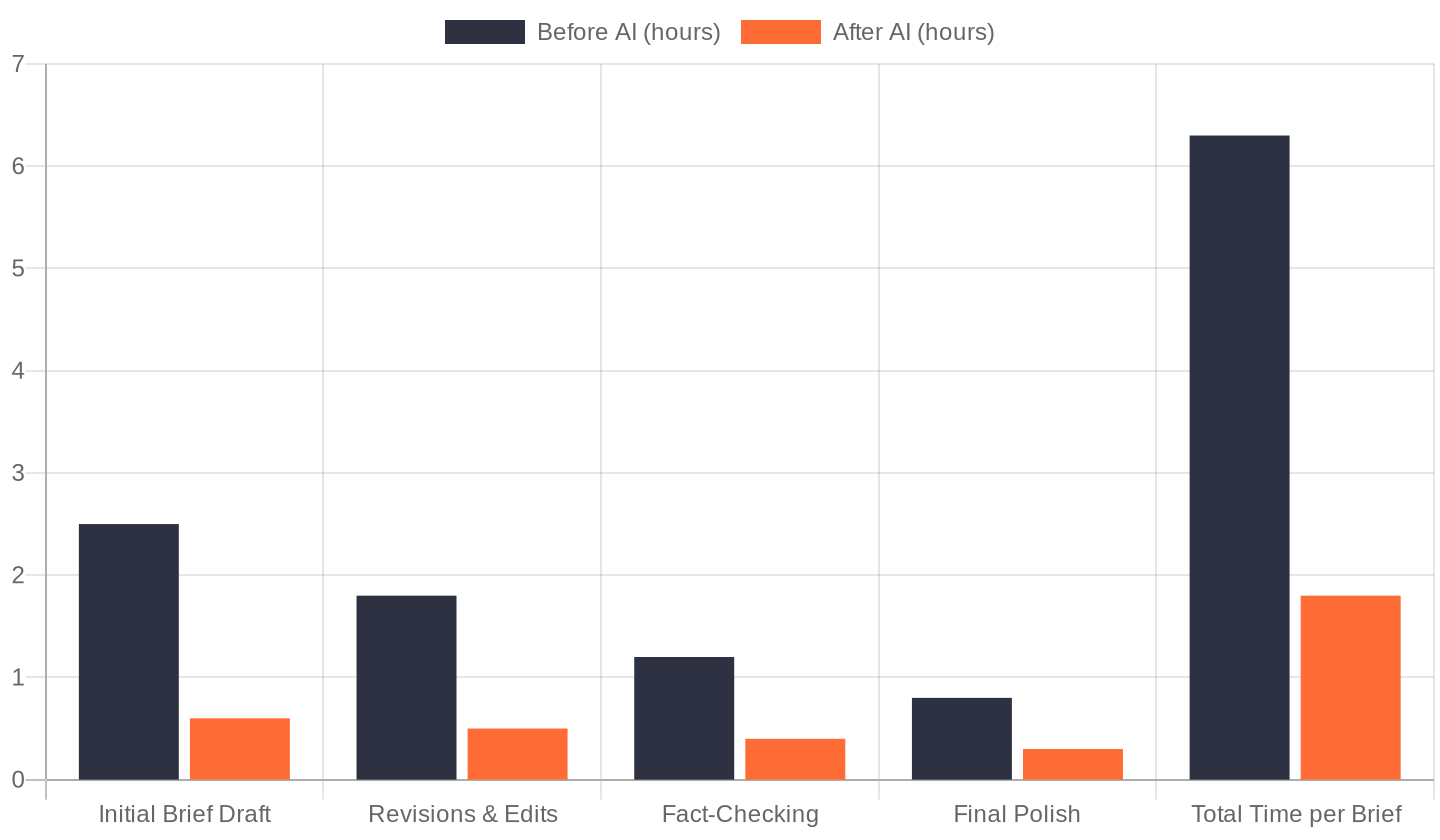
A 22-person marketing services firm was bleeding 40 hours per week on repetitive brief-writing and revisions. I mapped the actual process: creative lead spent 6 hours writing briefs, client feedback came in three rounds, each round took 2 hours to incorporate. We rebuilt it in two parts. First, we created a Claude-powered brief template that generated 80% of the structure based on client intake answers (cut writing time to 2 hours). Second, we moved feedback collection into Airtable with pre-defined revision categories (cut revision cycles from three rounds to one, saved 4 hours per brief). The team adopted this not because AI is cool—because they got 14 hours of their week back. Measured adoption at 90% consistent use after 45 days. No retraining needed. The work was objectively easier.
Scope and fit
This works for companies with 10-50 people where the owner or ops leader can directly see what's broken. You need a team willing to trial a process change for 30 days and give honest feedback on whether it actually works. Out of scope: replacing your core product with AI, fixing broken hiring or culture issues that have nothing to do with tools, or implementation at scale (500+ employees). This also doesn't work if your team is explicitly told they have no say in process changes—adoption requires buy-in, not compliance.
Expertise
I spent 4 years running operations for a 12-person digital agency, implementing AI across client work and internal processes—I built this methodology by failing at it twice before it worked. I've completed 18-24 engagements with small businesses over the last 3 years, focused entirely on adoption that sticks. I'm hands-on with ChatGPT, Claude, Perplexity, Make.com, Zapier, and Airtable—not the full tech stack, but the tools that actually solve problems at this scale.
Contact
Loading…